-

-

mustard yellow silk brocade embroidered in satin stitch
-
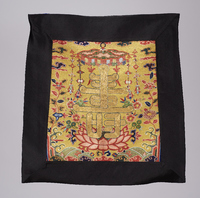
mustard yellow silk brocade embroidered in satin stitch
-

w/tassels
-

-

silk tassels
-
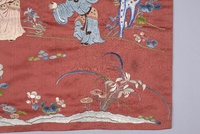
embroidery on red satin; figures in garden
-

crane in garden; embroidery on black
-

crane in garden; embroidery on black
-

crane in garden; embroidery on black
-
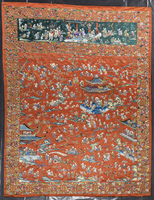
wedding gift, 100 children
-

<p>In Confucianism, the code of moral conduct associated with the teachings of the Chinese philosopher Confucius, or Kongzi <span lang="ZH-TW" style="font-family:"PMingLiU",serif">孔子</span>, 551-479 B.C.E., filial piety is the most important principle to regulate human relationships and maintain social order. Filial piety is defined as the humane and ethical behavior that should guide interactions among individuals, families, and members of every level of government, the healthy balance of which will result in a peaceful and harmonious society.</p>
<p>The <i>Classic of Filial Piety</i> (<i>Xiaojing</i> <span style="font-family:SimSun">孝經</span>), an anonymous text produced between the fourth and third century B.C.E., described proper behavior and became as influential in East Asia as sacred religious texts. The concept of filial piety was also promoted beyond Confucian doctrine: narratives of exemplary Buddhists touted their devotion to treating others with love and respect. Chinese stories about benevolence and loyalty express the deep-rooted conviction that a benevolent superior, whether ruler, official, or father, who does not abuse his power, but respects those in his care, will, in turn, enjoy the respect and obedience of his subjects and descendants.</p>
<p>During the Yuan dynasty (1260-1368), Guo Jujing (<span lang="ZH-TW" style="font-family:SimSun">郭居</span><span style="font-family:SimSun">敬</span>) composed an illustrated manual featuring stories from <i>Twenty-Four Paragons of Filial Piety</i> (<i>Ershisi Xiao</i><span lang="ZH-TW" style="font-family:SimSun">二十四孝</span>), which became the most prominent text used for teaching this concept. Designed to motivate the reader to emulate the behavior of virtuous individuals, the stories concentrate on the loyalty, obedience, and respect shown by those in the position of dependent.</p>
<p>In addition to the moral standards propagated in printed filial piety manuals, honor and respect for elders was often expressed at celebratory events, such as significant birthdays. The congratulatory paintings, wall hangings, and cards, and the festive attire worn on such occasions are often decorated with auspicious characters and images.</p>
<p>The selection of embroidered textiles depicting stories or scenes from the <i>Twenty-Four Paragons</i> included in this installation reflect the proliferation of the topic in Chinese literature and material culture. They are also included here as examples for various stitches of the exquisite embroideries in the Warner collection.</p>
-
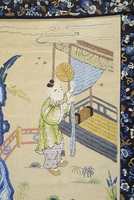
<p>In Confucianism, the code of moral conduct associated with the teachings of the Chinese philosopher Confucius, or Kongzi 孔子, 551-479 B.C.E., filial piety is the most important principle to regulate human relationships and maintain social order. Filial piety is defined as the humane and ethical behavior that should guide interactions among individuals, families, and members of every level of government, the healthy balance of which will result in a peaceful and harmonious society.</p>
<p>The <i>Classic of Filial Piety</i> (<i>Xiaojing</i> 孝經), an anonymous text produced between the fourth and third century B.C.E., described proper behavior and became as influential in East Asia as sacred religious texts. The concept of filial piety was also promoted beyond Confucian doctrine: narratives of exemplary Buddhists touted their devotion to treating others with love and respect. Chinese stories about benevolence and loyalty express the deep-rooted conviction that a benevolent superior, whether ruler, official, or father, who does not abuse his power, but respects those in his care, will, in turn, enjoy the respect and obedience of his subjects and descendants.</p>
<p>During the Yuan dynasty (1260-1368), Guo Jujing (郭居敬) composed an illustrated manual featuring stories from <i>Twenty-Four Paragons of Filial Piety</i> (<i>Ershisi Xiao</i>二十四孝), which became the most prominent text used for teaching this concept. Designed to motivate the reader to emulate the behavior of virtuous individuals, the stories concentrate on the loyalty, obedience, and respect shown by those in the position of dependent.</p>
<p>In addition to the moral standards propagated in printed filial piety manuals, honor and respect for elders was often expressed at celebratory events, such as significant birthdays. The congratulatory paintings, wall hangings, and cards, and the festive attire worn on such occasions are often decorated with auspicious characters and images.</p>
<p>The selection of embroidered textiles depicting stories or scenes from the <i>Twenty-Four Paragons</i> included in this installation reflect the proliferation of the topic in Chinese literature and material culture. They are also included here as examples for various stitches of the exquisite embroideries in the Warner collection.</p>
-

<p>In Confucianism, the code of moral conduct associated with the teachings of the Chinese philosopher Confucius, or Kongzi 孔子, 551-479 B.C.E., filial piety is the most important principle to regulate human relationships and maintain social order. Filial piety is defined as the humane and ethical behavior that should guide interactions among individuals, families, and members of every level of government, the healthy balance of which will result in a peaceful and harmonious society.</p>
<p>The <i>Classic of Filial Piety</i> (<i>Xiaojing</i> 孝經), an anonymous text produced between the fourth and third century B.C.E., described proper behavior and became as influential in East Asia as sacred religious texts. The concept of filial piety was also promoted beyond Confucian doctrine: narratives of exemplary Buddhists touted their devotion to treating others with love and respect. Chinese stories about benevolence and loyalty express the deep-rooted conviction that a benevolent superior, whether ruler, official, or father, who does not abuse his power, but respects those in his care, will, in turn, enjoy the respect and obedience of his subjects and descendants.</p>
<p>During the Yuan dynasty (1260-1368), Guo Jujing (郭居敬) composed an illustrated manual featuring stories from <i>Twenty-Four Paragons of Filial Piety</i> (<i>Ershisi Xiao</i>二十四孝), which became the most prominent text used for teaching this concept. Designed to motivate the reader to emulate the behavior of virtuous individuals, the stories concentrate on the loyalty, obedience, and respect shown by those in the position of dependent.</p>
<p>In addition to the moral standards propagated in printed filial piety manuals, honor and respect for elders was often expressed at celebratory events, such as significant birthdays. The congratulatory paintings, wall hangings, and cards, and the festive attire worn on such occasions are often decorated with auspicious characters and images.</p>
<p>The selection of embroidered textiles depicting stories or scenes from the <i>Twenty-Four Paragons</i> included in this installation reflect the proliferation of the topic in Chinese literature and material culture. They are also included here as examples for various stitches of the exquisite embroideries in the Warner collection.</p>
-

<p>In Confucianism, the code of moral conduct associated with the teachings of the Chinese philosopher Confucius, or Kongzi 孔子, 551-479 B.C.E., filial piety is the most important principle to regulate human relationships and maintain social order. Filial piety is defined as the humane and ethical behavior that should guide interactions among individuals, families, and members of every level of government, the healthy balance of which will result in a peaceful and harmonious society.</p>
<p>The <i>Classic of Filial Piety</i> (<i>Xiaojing</i> 孝經), an anonymous text produced between the fourth and third century B.C.E., described proper behavior and became as influential in East Asia as sacred religious texts. The concept of filial piety was also promoted beyond Confucian doctrine: narratives of exemplary Buddhists touted their devotion to treating others with love and respect. Chinese stories about benevolence and loyalty express the deep-rooted conviction that a benevolent superior, whether ruler, official, or father, who does not abuse his power, but respects those in his care, will, in turn, enjoy the respect and obedience of his subjects and descendants.</p>
<p>During the Yuan dynasty (1260-1368), Guo Jujing (郭居敬) composed an illustrated manual featuring stories from <i>Twenty-Four Paragons of Filial Piety</i> (<i>Ershisi Xiao</i>二十四孝), which became the most prominent text used for teaching this concept. Designed to motivate the reader to emulate the behavior of virtuous individuals, the stories concentrate on the loyalty, obedience, and respect shown by those in the position of dependent.</p>
<p>In addition to the moral standards propagated in printed filial piety manuals, honor and respect for elders was often expressed at celebratory events, such as significant birthdays. The congratulatory paintings, wall hangings, and cards, and the festive attire worn on such occasions are often decorated with auspicious characters and images.</p>
<p>The selection of embroidered textiles depicting stories or scenes from the <i>Twenty-Four Paragons</i> included in this installation reflect the proliferation of the topic in Chinese literature and material culture. They are also included here as examples for various stitches of the exquisite embroideries in the Warner collection.</p>
-
-
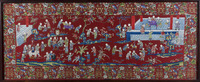
Almost same composition as [but with different colors than] MWCH46:17
-
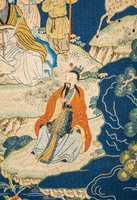
<p>The Queen Mother of the West Xiwangmu (西王母) is associated with the female principle <em>yin</em> 陰, the element metal, the western direction, and the autumn season. In the Daoist school of Highest Purity (Shangqing 上清), she is believed to control the length of human life. Her paradise realm is thought to be in the remote Kunlun Mountains and to include a garden with peach trees that bear fruit only once every 3000 years. These are the famed peaches of immortality, which the Queen Mother of the West only offers to those deemed virtuous enough to transcend into the abode of the immortals. Her garden is filled with animals that symbolize qualities such as longevity and peace (<em>he</em> 和, symbolized by a crane, <em>he</em> 鶴), and wealth acquired through a good emolument (<em>lu</em> 錄, symbolized by a deer, <em>lu</em> 鹿).</p>
<p>One famous legend relating to the Queen Mother of the West is shown in this hanging, where she is seen traveling through the clouds, approaching the immortals who have gathered for the birthday celebration she hosts beside Jasper Lake. At left, servants carry an enormous peach in preparation for the banquet.</p>
<p>Such a <em>kesi</em> hanging was commissioned to be gifted as a grand gesture for a renowned personality celebrating a high numbered birthday.</p>
-
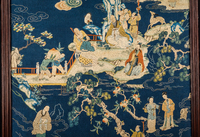
<p>The Queen Mother of the West Xiwangmu (西王母) is associated with the female principle <em>yin</em> 陰, the element metal, the western direction, and the autumn season. In the Daoist school of Highest Purity (Shangqing 上清), she is believed to control the length of human life. Her paradise realm is thought to be in the remote Kunlun Mountains and to include a garden with peach trees that bear fruit only once every 3000 years. These are the famed peaches of immortality, which the Queen Mother of the West only offers to those deemed virtuous enough to transcend into the abode of the immortals. Her garden is filled with animals that symbolize qualities such as longevity and peace (<em>he</em> 和, symbolized by a crane, <em>he</em> 鶴), and wealth acquired through a good emolument (<em>lu</em> 錄, symbolized by a deer, <em>lu</em> 鹿).</p>
<p>One famous legend relating to the Queen Mother of the West is shown in this hanging, where she is seen traveling through the clouds, approaching the immortals who have gathered for the birthday celebration she hosts beside Jasper Lake. At left, servants carry an enormous peach in preparation for the banquet.</p>
<p>Such a <em>kesi</em> hanging was commissioned to be gifted as a grand gesture for a renowned personality celebrating a high numbered birthday.</p>
-
-
-
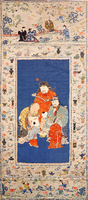
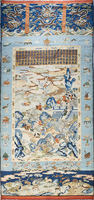
<p>The scene at the top of this hanging shows a chapter titled ‘The Circle of Insignia’ from the drama ‘The Insignia-Laden Bed (Manchuang hu 满床笏)’, by playwright Fan Xizhe 範希哲 (fl. 1673). It tells the popular story of the famous Tang general Guo Ziyi 郭子儀 (697-781). Loyal to the dynastic house of Li, this general of Nestorian Christian faith fought against the Uighur and Tibetan empires. He is most prominently commemorated for successfully ending the two years of devastating uprisings under leadership of general An Lushan 安禄山 (c. 703-757), the so called An Lushan Rebellion or An Lushan Chaos.</p>
<p>Guo was later deified as the star god Lu of the three gods Fu (symbolizing prosperity), Lu (symbolizing emolument), and Shou (symbolizing longevity), related to the legend that the Jade Emperor, who had observed Guo’s loyal service to three Tang emperors with great appreciation, had sent a fairy to inquire about Guo’s desires. Guo responded that since he had seen so much bloodshed in his life he wished for peace and happiness. Thereupon the Jade emperor rewarded him with the position as God of Emolument.</p>
<p>The depiction on the hanging shows how on the occasion of Guo’s sixtieth birthday his seven sons and eight sons-in-law, all of them also accomplished in their service as high-ranking imperial officials, lay the tablets inscribed with their respective ranks in the shape of the character ‘<em>shou</em>’ 壽 (longevity) on top of a day-bed, to symbolize their wish for a long life for Guo.</p>
<p>The scene was performed on the occasion of advanced birthdays and adorned celebratory banners and other gifts.</p>
-
-
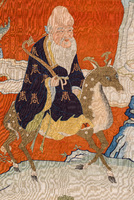
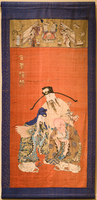
<p>This festive <i>kesi</i> tapestry depicts Shoulao, the God of Longevity, riding a spotted deer (with antlers in the form of magic <i>lingzhi</i> mushrooms) into an auspicious landscape and being welcoming by the Eight Daoist immortals. The scene is surrounded by a border of bats and mushroom-shaped clouds, both auspicious symbols, bearing the well-wishing greetings to the receiver of this hanging, most likely on the occasion of a high numbered birthday.</p>
-
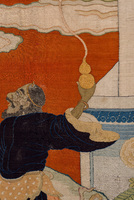
<p>This festive <i>kesi</i> tapestry depicts Shoulao, the God of Longevity, riding a spotted deer (with antlers in the form of magic <i>lingzhi</i> mushrooms) into an auspicious landscape and being welcoming by the Eight Daoist immortals. The scene is surrounded by a border of bats and mushroom-shaped clouds, both auspicious symbols, bearing the well-wishing greetings to the receiver of this hanging, most likely on the occasion of a high numbered birthday.</p>